Component#
- class cosmolayer.cosmosac.Component(cosmo_string, *, min_sigma=-0.025, max_sigma=0.025, num_points=51, averaging_radius=np.float64(1.5191269449366247), f_decay=3.57, sigma_0=0.007, merge_profiles=False)[source]#
Molecular component for the COSMO-SAC activity coefficient model.
- Parameters:
cosmo_string (str) – Contents of a COSMO output file from quantum mechanical calculations.
- Keyword Arguments:
min_sigma (float, optional) – Minimum screening charge density in e/Ų. Default is -0.025 e/Ų.
max_sigma (float, optional) – Maximum screening charge density in e/Ų. Default is 0.025 e/Ų.
num_points (int, optional) – Number of discrete points in the sigma profile. Default is 51.
averaging_radius (float, optional) – Effective radius for distance-weighted sigma averaging in Å. Default is √(7.25 / π) Å [1].
f_decay (float, optional) – Decay factor for exponential distance weighting in the sigma averaging procedure. Default is 3.57 [1].
sigma_0 (float or None, optional) – Standard deviation of the Gaussian probability of a segment to form a hydrogen bond in e/Ų. Set to
Noneto disable hydrogen-bond splitting (all surface area is assigned to the NHB class). Default is 0.007 e/Ų [1].merge_profiles (bool, optional) – Whether to merge segment groups (NHB, OH, OT) into a single profile when accessing
probabilitiesandsigma_profile. Default is False.
- Raises:
ValueError – If the COSMO string is not in any supported format.
ValueError – If averaged charge densities fall outside the specified sigma range.
Examples
>>> import numpy as np
>>> from importlib.resources import files
>>> from cosmolayer.cosmosac import Component
>>> path = files("cosmolayer.data") / "C=C(N)O.cosmo"
>>> component = Component(path.read_text())
>>> component.area
97.34554...
>>> component.volume
80.07160...
When
merge_profilesis True,sigma_profileis a single merged profile:>>> component = Component(path.read_text(), merge_profiles=True) >>> sigma_profile = component.sigma_profile >>> sigma_profile.shape (51,) >>> print(sum(sigma_profile)) 97.34554...
When
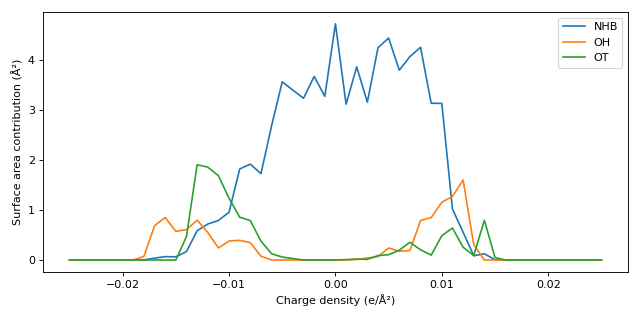
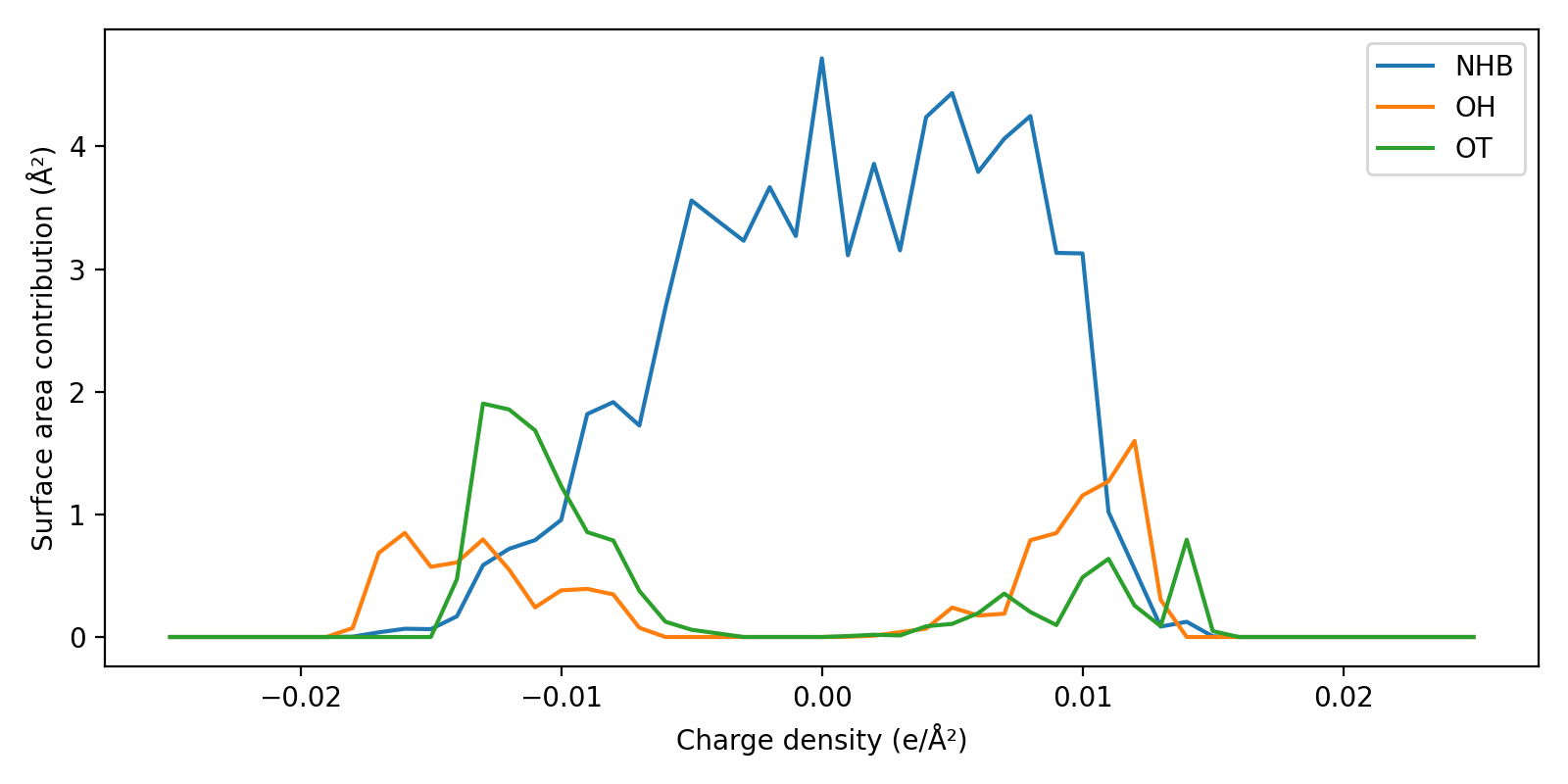
merge_profilesis False,sigma_profileis stacked (NHB, OH, OT), shape (3, num_points):>>> component = Component(path.read_text(), merge_profiles=False) >>> stacked = component.sigma_profile >>> stacked.shape (3, 51) >>> from cosmolayer.cosmosac.segment_groups import SEGMENT_GROUPS >>> for i, s in enumerate(SEGMENT_GROUPS): ... print(s, sum(stacked[i])) NHB 72.31802... OH 12.25732... OT 12.77019...
Plotting the sigma profiles (stacked,
merge_profilesis False):>>> from importlib.resources import files >>> from cosmolayer.cosmosac import Component >>> from cosmolayer.cosmosac.segment_groups import SEGMENT_GROUPS >>> from matplotlib import pyplot as plt >>> path = files("cosmolayer.data") / "C=C(N)O.cosmo" >>> component = Component(path.read_text(), merge_profiles=False) >>> fig, ax = plt.subplots(figsize=(8, 4)) >>> grid = component.sigma_grid >>> for i, label in enumerate(SEGMENT_GROUPS): ... _ = ax.plot(grid, component.sigma_profile[i], label=label) >>> _ = ax.set_xlabel("Charge density (e/Ų)") >>> _ = ax.set_ylabel("Surface area contribution (Ų)") >>> _ = ax.legend() >>> fig.tight_layout()
(
Source code,png,hires.png,pdf)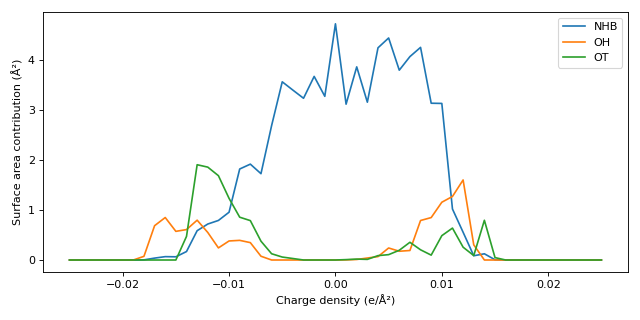
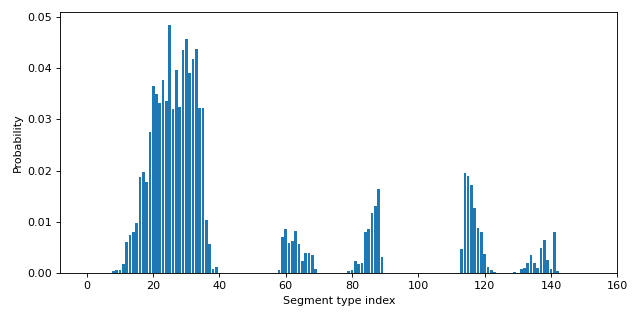
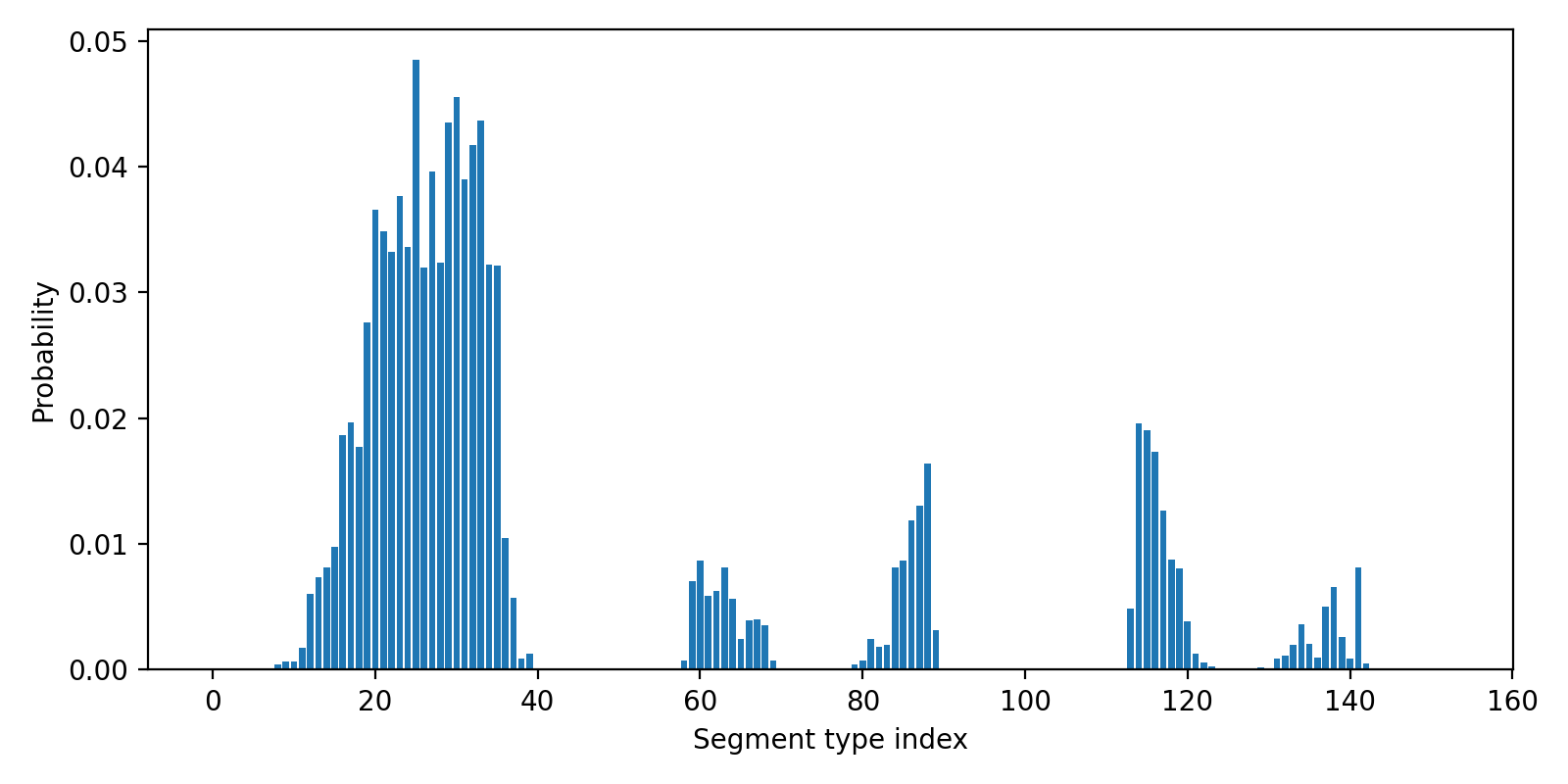
Plotting the segment-type probabilities:
>>> from importlib.resources import files
>>> from cosmolayer.cosmosac import Component
>>> from matplotlib import pyplot as plt
>>> path = files("cosmolayer.data") / "C=C(N)O.cosmo"
>>> component = Component(path.read_text())
>>> fig, ax = plt.subplots(figsize=(8, 4))
>>> p = component.probabilities
>>> _ = ax.bar(range(len(p)), p)
>>> _ = ax.set_xlabel("Segment type index")
>>> _ = ax.set_ylabel("Probability")
>>> fig.tight_layout()
(
Source code,png,hires.png,pdf)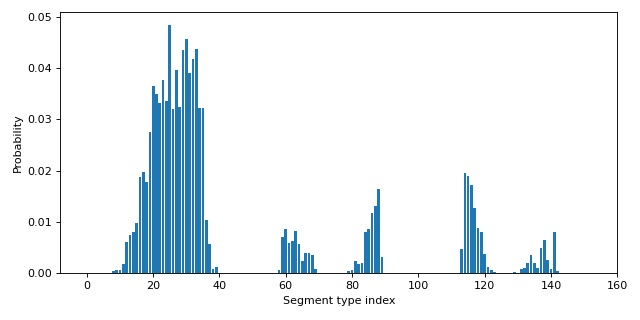
Attributes
- area#
Cavity surface area of the molecule in Ų.
Sum of the areas of all segments from the COSMO calculation.
- atom_data#
Atom data from the parsed COSMO file.
DataFrame columns:
id(atom identifier),x,y,z(Cartesian coordinates in Å),element(chemical symbol).- Returns:
One row per atom.
- Return type:
pd.DataFrame
Examples
>>> from importlib.resources import files
>>> from cosmolayer.cosmosac import Component
>>> path = files("cosmolayer.data") / "C=C(N)O.cosmo"
>>> component = Component(path.read_text())
>>> component.atom_data
   id       x       y       z element
0  C1 -1.4... -0.2...  0.0...       C
1  C2 -0.0...  0.0...  0.0...       C
2  N1  0.9... -0.9... -0.0...       N
...
8  H5  1.1...  1.3... -0.4...       H
- bonds#
Bonds between atoms, inferred from interatomic distances.
Examples
>>> from importlib.resources import files
>>> from cosmolayer.cosmosac import Component
>>> path = files("cosmolayer.data") / "C=C(N)O.cosmo"
>>> component = Component(path.read_text())
>>> component.bonds
[(0, 1), (0, 4), (0, 5), ... (2, 7), (3, 8)]
- cosmo_format#
COSMO file format that was parsed.
Either “TURBOMOLE” or “DMol-3”.
Examples
>>> from importlib.resources import files
>>> from cosmolayer.cosmosac import Component
>>> path = files("cosmolayer.data") / "C=C(N)O.cosmo"
>>> component = Component.from_file(path)
>>> component.cosmo_format
'TURBOMOLE'
>>> path = files("cosmolayer.data") / "NCCO.cosmo"
>>> component = Component.from_file(path)
>>> component.cosmo_format
'DMol-3'
- merge_profiles#
Whether segment groups (NHB, OH, OT) are merged for
sigma_profileandprobabilities.- Return type:
- probabilities#
Normalized segment-type probability distribution (sigma profile / area).
Segment types are defined by hydrogen bonding class (NHB, OH, OT) and averaged charge density. Shape is
(num_points,)ifmerge_profilesis True, otherwise(3*num_points,).- Returns:
Probabilities summing to 1.0.
- Return type:
np.ndarray
Examples
>>> import numpy as np
>>> from importlib.resources import files
>>> from cosmolayer.cosmosac import Component
>>> cosmo_string = (files("cosmolayer.data") / "C=C(N)O.cosmo").read_text()
>>> component = Component(cosmo_string, merge_profiles=True)
>>> probabilities = component.probabilities
>>> probabilities.shape
(51,)
>>> bool(np.all(probabilities <= 1))
True
>>> bool(np.isclose(probabilities.sum(), 1.0))
True
>>> component = Component(cosmo_string, merge_profiles=False)
>>> probabilities_full = component.probabilities
>>> probabilities_full.shape
(153,)
>>> bool(np.isclose(probabilities_full.sum(), 1.0))
True
- segment_data#
Segment (surface tile) data from the COSMO calculation.
DataFrame columns:
atom(parent atom index),x,y,z(segment centroid coordinates in Å),charge(e),area(Ų),sigma(screening charge density in e/Ų),sigma_avg(smoothed density in e/Ų).- Returns:
One row per segment.
- Return type:
pd.DataFrame
Examples
>>> from importlib.resources import files
>>> from cosmolayer.cosmosac import Component
>>> path = files("cosmolayer.data") / "C=C(N)O.cosmo"
>>> component = Component(path.read_text())
>>> component.segment_data
     atom         x         y  ...      area     sigma  sigma_avg
0       0 -0.867... -1.196...  ...  0.206...  0.010...   0.007...
1       0 -1.504... -1.502...  ...  0.218...  0.007...   0.005...
...
470     8  2.133...  1.152...  ...  0.145... -0.012...  -0.009...

[471 rows x 8 columns]
- sigma_grid#
Get the screening charge density grid in e/Ų.
- Returns:
Charge density vector in e/Ų.
- Return type:
np.ndarray
Examples
>>> from importlib.resources import files
>>> from cosmolayer.cosmosac import Component
>>> path = files("cosmolayer.data") / "C=C(N)O.cosmo"
>>> component = Component(path.read_text())
>>> component.sigma_grid
array([-0.025, -0.024, -0.023, ... 0.023,  0.024,  0.025])
- sigma_profile#
Surface area distribution over screening charge density (sigma), in Ų.
Shape and layout depend on
merge_profiles. If True, returns a single merged profile (sum over NHB, OH, OT), shape(num_points,). If False, returns stacked segment profiles in SEGMENT_GROUPS order (NHB, OH, OT), shape(3, num_points);sigma_profile[0]is NHB,[1]is OH,[2]is OT.- Returns:
Sigma profile(s). Units: Ų.
- Return type:
np.ndarray
- volume#
Cavity volume of the molecule in ų.
Methods
- classmethod from_file(file_path)[source]#
Create a component from a COSMO output file.
Note
This method creates a component with default parameters.
- Parameters:
file_path (path-like or Traversable) – Path to the COSMO output file.
- Returns:
Component object.
- Return type:
Examples
>>> from importlib.resources import files
>>> from cosmolayer.cosmosac import Component
>>> path = files("cosmolayer.data") / "C=C(N)O.cosmo"
>>> component = Component.from_file(path)
>>> component.area, component.volume
(97.34554..., 80.07160...)
- classmethod from_text_reader(text_reader)[source]#
Create a component from a text reader.
Note
This method creates a component with default parameters.
- Parameters:
text_reader (io.TextIO) – Text reader to read the COSMO output file from.
- Returns:
Component object.
- Return type:
Examples
>>> from importlib.resources import files
>>> from cosmolayer.cosmosac import Component
>>> path = files("cosmolayer.data") / "C=C(N)O.cosmo"
>>> with open(path, encoding="utf-8") as file:
...     component = Component.from_text_reader(file)
>>> component.area, component.volume
(97.34554..., 80.07160...)